6 Reasons Your Reset Collapses the First Week the Weather Turns
Quick Answer: Seasonal collapse of a diet reset is driven by six things arriving together: appetite genuinely rises as temperatures drop, daylight shortens and shifts your evening habits, activity falls when outdoor movement gets harder, comfort food becomes the default, sleep timing drifts, and social eating clusters into autumn. None of these is a discipline failure. Each has a specific fix, and the whole thing is predictable enough to plan around.
You were three weeks into a reset and it was going well.
Then the first genuinely cold week arrived, and by Friday the whole thing had quietly stopped.
Same plan. Same you. Different season.
This is general information, not medical or nutrition advice.

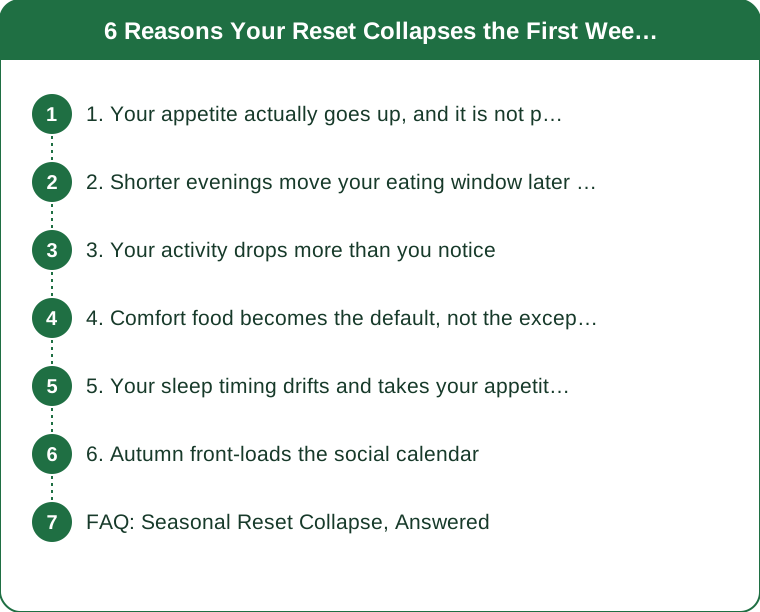
1. Your appetite actually goes up, and it is not psychological
Cooler temperatures increase energy expenditure slightly through thermoregulation, and appetite responds. This is a real, measurable seasonal pattern rather than a story people tell themselves.
The increase is modest — nowhere near enough to justify the amount of extra food most people end up eating — but it is enough to make a calorie target that felt easy in August feel restrictive in October.
The problem is the mismatch in perception. You built the plan when your appetite was naturally suppressed by heat, and now you are running the same plan against a genuinely hungrier body while assuming nothing changed.
The fix: raise protein and fiber before you raise willpower. Both increase satiety per calorie, which is exactly what you need when hunger goes up and your target has not. A small planned increase in total intake is also a legitimate answer — a plan you can follow at a slightly higher number beats a plan you abandon at the lower one.
2. Shorter evenings move your eating window later and looser
Darkness at 7pm does something specific to eating behavior. It signals the end of the active day earlier, which pulls the evening wind-down forward, and the evening wind-down is when most unplanned eating happens.
In summer, an 8pm walk or a bright evening kept you occupied through the window where snacking usually starts. That structure disappears in autumn and nothing replaces it.
Most people describe this as suddenly snacking more in the evenings without any change in hunger. The hunger did not change. The empty time did.
The fix: replace the structure rather than resisting the snacking. Something occupying the 7pm to 9pm window — a task, an activity, an actual scheduled thing — removes the problem more reliably than any amount of not-eating. Front-loading more of your daily calories earlier also helps, because the evening window arrives with less deficit to fight.
3. Your activity drops more than you notice
The visible workouts usually survive the season. What quietly disappears is everything else.
Walking to places rather than driving, the evening stroll, weekend outdoor plans, standing around outside, the general background movement of warm months — all of it falls off, and none of it was tracked.
For many people that background activity is a larger share of daily expenditure than their workouts. Losing it is a meaningful drop that shows up nowhere in your training log, which is why the plan appears to stop working for no reason.
The fix: track steps rather than workouts for a couple of weeks. If your daily average has dropped substantially since August, you found your answer. Then protect the walk specifically — schedule it, in daylight, as a fixed appointment. It is the single highest-value habit to defend going into winter, and it is the first one people drop.

4. Comfort food becomes the default, not the exception
Cooler weather shifts food preference toward warm, dense, higher-calorie options. Some of that is physiological, plenty of it is cultural, and all of it is happening in your kitchen at the same time.
The issue is not any individual meal. It is that the default changed. Summer defaults — salads, cold proteins, fruit, minimally cooked vegetables — happened to be relatively low in calorie density. Autumn defaults are not.
So you can make exactly the same number of decisions with exactly the same discipline and end up meaningfully higher, because the baseline moved underneath you.
The fix: rebuild the defaults rather than resisting them. Soups, stews, and roasted vegetables are all warm, comforting, seasonal, and entirely compatible with a reset. Trying to eat a summer diet through October is a losing strategy and it is what most plans attempt.
5. Your sleep timing drifts and takes your appetite with it
Less morning light and earlier darkness shift circadian timing for most people. Bedtimes get later, mornings get harder, and sleep quality often dips through the transition.
That matters here because short or poorly timed sleep reliably affects appetite regulation — hunger signals increase, fullness signals weaken, and preference shifts toward higher-calorie foods. It also reduces the mental resources available for any plan requiring decisions.
So a plan that was running on seven and a half hours of well-timed sleep in August is now running on six and a half poorly timed hours in October, against a body that is hungrier for independent reasons.
The fix: get morning light within the first hour of waking, even on grey days — outdoor light on an overcast morning is still far brighter than indoor lighting. Protect the bedtime rather than the wake time. And treat sleep as part of the reset rather than as something separate from it.
6. Autumn front-loads the social calendar
Summer social eating is spread out and often lighter — outdoor, casual, and frequently built around a walk or an activity. Autumn social eating clusters, moves indoors, and centers on the meal itself.
The calendar also densifies. Back to school, work restarting properly, birthdays, and the run-up to the holiday season all land in the same eight weeks.
The result is more high-calorie social occasions in a shorter window, at exactly the time when the other five factors are already working against you.
The fix: look at the next six weeks now and count the events. If there are eight, a plan that assumes zero will fail. Build the plan around the real number — eat normally around them, do not attempt to compensate by restricting the day before or after, and accept that the rate of progress through this period will be slower. A slower plan that survives the season beats an aggressive one that ends in week three.
FAQ: Seasonal Reset Collapse, Answered
Should I just wait and start in January?
No. January has all six of these factors plus post-holiday disruption, and it is the single most abandoned start date of the year. A reset started now, adjusted for the season, is running against fewer headwinds than one started in six weeks.
Is it normal to gain weight in autumn even without changing anything?
Some seasonal fluctuation is very common and much of it is fluid and food volume rather than fat. The pattern of a modest autumn rise and a spring fall is well documented and not a personal failing.
Which of the six matters most?
Activity, for most people. The drop in background movement is usually the largest single change and the least noticed. Track steps for two weeks and you will know whether it is yours.
Do I need to change my calorie target?
Possibly, and in either direction. If your activity dropped, your maintenance dropped with it. If your appetite rose substantially, a slightly higher, sustainable target may serve you better than an unsustainable lower one. Adjust deliberately rather than by drift.
TL;DR:
- Appetite genuinely rises as temperatures fall — plan for it with protein and fiber rather than willpower.
- Shorter evenings create empty time where snacking lives; replace the structure, not just the snack.
- Background activity falls far more than workouts do, and it is usually the largest hidden change.
- Comfort food shifts your defaults upward, so rebuild the defaults seasonally instead of eating a summer diet in October.
- Sleep timing drifts and takes appetite regulation with it — morning light and a protected bedtime are part of the plan.
- Autumn clusters social eating into eight weeks; count the events and build a slower plan that survives them.
The reason this feels like a discipline failure every year is that all six arrive within about a fortnight of each other. Nothing about you changed. Adjust for the season deliberately in the next two weeks and the reset that usually dies in September becomes the one still running in December.
Keep Reading
This article is for general informational and styling purposes only. Fit, sizing, and product availability may vary.