7 Reasons Your Reset Works at Home and Falls Apart at Work
Quick Answer: A reset that holds at home and collapses at work is almost never a willpower problem. Home is an environment you control — the food, the timing, the interruptions. Work is one you do not, and it removes all three at once. The fix is to stop trying to be more disciplined at work and start making decisions before you arrive, because the decision-making is the part that fails, not the intention.
If your weekdays look nothing like your weekends, this list is where the difference lives.
And fixing two or three of these usually fixes the whole week.

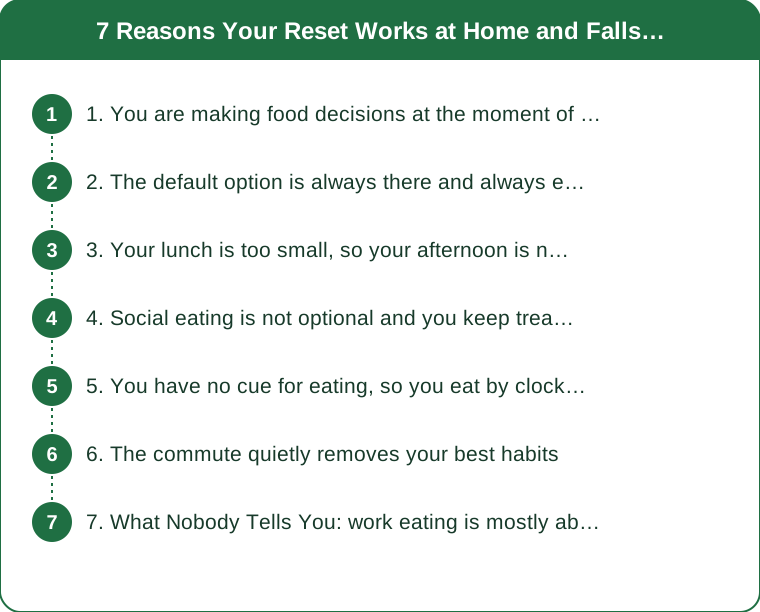
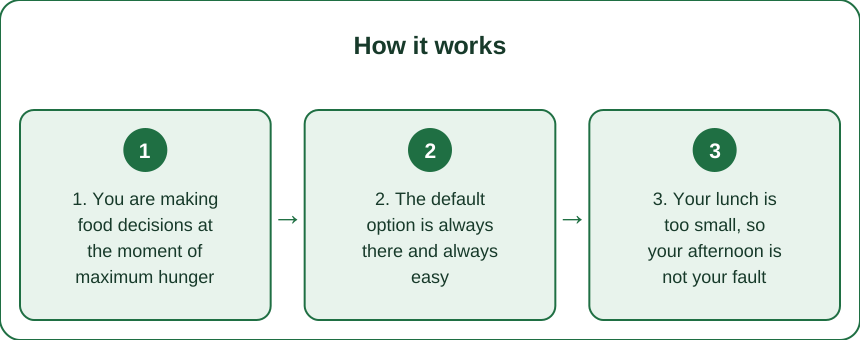
1. You are making food decisions at the moment of maximum hunger
At home, the decision and the eating are close together and you are usually not desperate. At work, you decide what to eat at 12:45 when you are genuinely hungry, often after skipping breakfast or having a light one.
Hunger changes what you choose, reliably and substantially. Research on decision-making under hunger is consistent — high-calorie, high-reward foods become disproportionately attractive.
The fix: decide the night before, or at least in the morning. It does not have to be a prepared meal; it can be a decision. Today I am having the soup and a chicken wrap. Made at 8am, that decision holds. Made at 12:45, it does not.
2. The default option is always there and always easy
At home, eating something unhelpful requires having bought it. At work, it is in the canteen, the vending machine, the meeting room, or the tin someone brought in — permanently, at no effort, at eye level.
Environmental availability is one of the strongest predictors of what people actually eat, far stronger than intention. You are not choosing between your plan and the biscuits once. You are choosing perhaps fifteen times a day.
The fix: create a competing default. A drawer with something you genuinely like — nuts, a decent protein bar, fruit — means the easy option and the reasonable option are the same distance away. Removing the biscuits is not usually within your power. Matching them is.
3. Your lunch is too small, so your afternoon is not your fault
Home lunches tend to be real meals. Work lunches are often a sandwich and a coffee, eaten quickly, delivering perhaps 400 calories and 15g of protein.
That is not enough to get anyone to 6pm, so the afternoon becomes a slow negotiation with the kitchen. People then interpret the 4pm snacking as a discipline failure, when it is a straightforward consequence of an undersized lunch.
The fix: make lunch bigger, specifically in protein and fibre. Aim for 30g of protein and something with real volume. A lunch that costs 150 more calories and prevents 400 calories of afternoon grazing is an obvious trade — and it is the single highest-return change on this list.

4. Social eating is not optional and you keep treating it as a failure
Team lunches, birthday cake, client dinners, someone’s leaving do. At home you decide when there is cake. At work you do not, and it arrives without warning.
The damaging part is rarely the cake. It is the interpretation — I have broken the reset — and the abandonment of the rest of the day that follows. One slice of cake is a couple of hundred calories. One slice of cake plus an abandoned afternoon and evening is a genuinely different number.
The fix: build it into the plan explicitly. Assume two or three unplanned food events a week, because that is realistic, and decide in advance that they do not end the day. A reset that cannot survive a colleague’s birthday is not a reset; it is a holiday from eating.
5. You have no cue for eating, so you eat by clock and by prompt
At home, meals attach to structure — you cook, you sit, you eat. At work, food attaches to events: a meeting ending, a colleague going to the shop, a task finishing, a moment of boredom.
Those cues have nothing to do with hunger, and there are far more of them than there are meals. This is why people eat more at work while feeling like they ate less.
The fix: give yourself a deliberate structure. A set lunch time, one planned afternoon snack, and a rule that food happens away from your desk. The last one is more powerful than it sounds — most incidental workplace eating is eaten at a desk while doing something else, and it barely registers as eating at all.
6. The commute quietly removes your best habits
Evening exercise, cooking properly, an early night — all of these are the first things a commute takes. A reset built on a Sunday, when you had four free hours, assumes a version of your day that does not exist on Wednesday.
This is why resets so often survive the weekend and die on Tuesday. The plan was designed by your weekend self for your weekday self, and they have very different amounts of time.
The fix: design the plan around your worst weekday, not your best. If the plan works on the day you get home at seven and are exhausted, it will work on every other day. If it only works on Sunday, it works one day in seven.
7. What Nobody Tells You: work eating is mostly about energy, not food
The final reason is the one people are most reluctant to look at. A great deal of workplace eating is regulating something other than hunger — fatigue, boredom, stress, or the need for a break from a screen.
Food works for this. It provides a genuine pause, a small reward, and a legitimate reason to stand up. Removing the food without replacing the function is why the sensible plan lasts four days.
The fix: replace the function directly. A five-minute walk outside, a proper cup of tea made slowly, two minutes at a window. What you are actually after at 3:30 is usually a break, and the biscuit is simply the most socially acceptable way to take one.
When people add a genuine afternoon break, the afternoon snacking often reduces without any effort applied to the food at all.
This is general information, not personalised nutrition advice.
TL;DR:
- Work removes control over food, timing, and interruptions all at once
- Decide what you are eating before you are hungry — the decision is what fails, not the intention
- An undersized lunch causes the afternoon, so aim for 30g of protein at midday
- Plan for two or three unplanned food events a week rather than treating them as failures
- Much of workplace eating is a break in disguise; give yourself the break directly
You do not need a different plan. You need the same plan to survive the eight hours where you control the least — and every fix on this list happens before you get to your desk, not while you are sitting at it.
Keep Reading
This article is for general informational and styling purposes only. Fit, sizing, and product availability may vary.