7 Reasons a Reset Started Now Outlasts One Started in January
Quick Answer: A reset started in late summer benefits from returning structure, favorable weather, natural schedule anchors, lower social pressure, better daylight, less all-or-nothing framing, and a longer runway before the holidays. January resets have almost none of these — they start in the darkest, coldest, most socially disrupted month, immediately after a period of excess, with maximum expectation attached. Timing does not do the work for you, and it decides how much friction you are working against.
Here are the seven, and what to do with each.

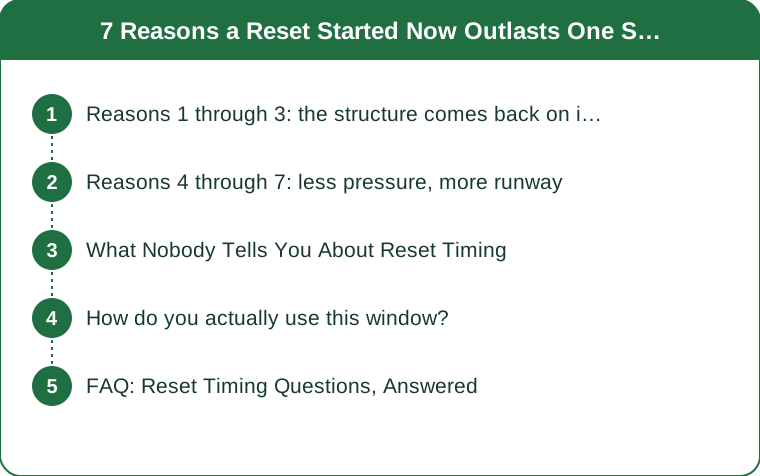
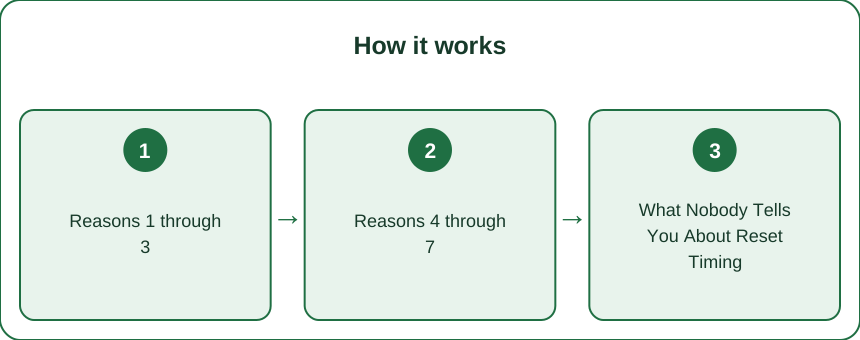
Reasons 1 through 3: the structure comes back on its own
1. School and work schedules resume, which rebuilds your week
Summer dissolves routine. Different wake times, holidays, disrupted weeks, and evening plans that appear at short notice. From late August through September, that structure returns without you having to build it.
Habits attach to structure. A workout that happens after the school run has an anchor; a workout that happens at some point in the day does not. The single biggest predictor of whether a new habit survives is whether it is attached to something that already happens reliably, and September hands you a whole set of those anchors for free.
2. The weather is on your side for another eight weeks
Outdoor activity in September and October is easier than in almost any other window. Mornings are cool enough to be comfortable and mild enough not to require gear you do not own yet.
A January reset asks you to start walking or running in cold and darkness, which is a substantially harder ask for someone who is not yet in the habit. Starting now means the habit is established before the weather turns, and an established habit survives bad conditions far better than a new one does.
3. Produce is at its peak, so eating well is easier
Eating more vegetables in late summer is not a discipline problem. Tomatoes, peppers, corn, squash, stone fruit, and berries are all at their best simultaneously, which almost never happens at any other point in the year.
A January reset asks you to eat more vegetables when the available produce is at its most limited and expensive. The same intention meets much more resistance.
Reasons 4 through 7: less pressure, more runway
4. Nobody is watching, which lowers the stakes
A January reset is a public event. Everyone starts, everyone talks about it, and quitting is visible. That social pressure sounds motivating and mostly raises the cost of an ordinary bad week, which turns a normal stumble into a failure narrative.
A late-summer reset is private. There is no cultural script, no expectation, and consequently no shame attached to adjusting it. Adjusting rather than abandoning is what makes something last.
5. There is no all-or-nothing framing attached
January comes with a fresh-start narrative that quietly demands perfection. Day one of a new year carries symbolic weight, so day four going badly feels like the whole thing failed.
A reset started on an ordinary Tuesday in August has no such symbolism, which means a bad day is just a bad day. This sounds like a small psychological difference and it is one of the largest predictors of whether people continue past week two.
6. You have a long runway before the holidays
Starting now gives roughly three months before the holiday season genuinely disrupts things. Three months is enough to establish habits that survive disruption rather than being destroyed by it.
The person who starts in September arrives at December with an established routine and a bad fortnight. The person who starts in January is building from nothing every single year.
7. Daylight is still working in your favor
Morning light is still good enough for early sessions, and evenings are still light enough for after-work activity. That window is closing — which is exactly the argument for starting now rather than waiting.
By November, both ends of the day are dark, and an unestablished habit rarely survives that transition. An established one usually does.

What Nobody Tells You About Reset Timing
The best reset is the one you can still be doing in six weeks, not the one that produces the fastest first week. Timing matters because it changes how much friction week five contains, not week one.
September is the second new year, and it is the better one. Everyone already treats it as a fresh start because of school schedules, without any of January’s baggage.
Starting small is easier when nobody is watching. The private nature of a late-summer reset makes a modest start psychologically acceptable, whereas January pressure pushes people toward dramatic overhauls that do not survive.
Motivation is not the variable that decides this. January has more motivation than any other month and the worst outcomes. Structure, weather, and social context predict persistence far better than enthusiasm does.
You do not need to wait for September 1st. The structure returns gradually through the second half of August. Starting mid-transition is genuinely fine, and waiting for a clean start date is one of the more reliable ways to not start.
A reset that survives one disruption is more established than one that has never met one. The first holiday weekend, the first travel week, the first illness — getting through one of those and continuing is the real milestone, and it is worth more than any number on a scale.
How do you actually use this window?
Six steps, sized for a start you can maintain.
Attach to the anchors that just reappeared. Identify the two or three things that now happen reliably every weekday — the school run, the commute, the start of work — and attach one habit to one of them. Not three habits to three anchors.
Start with sleep and walking, not with food restriction. Both are easier now than they will be in December, both compound, and neither creates the deprivation that makes resets collapse.
Use the produce while it is here. Build the eating changes around what is genuinely good right now rather than around a rule. A late-summer plate is naturally colorful, and this is the one month where that requires no effort.
Set a six-week horizon, not a twelve-week one. Six weeks from mid-August lands at the end of September, which is a real checkpoint and a survivable distance.
Plan for the daylight change now. Decide what the morning routine becomes when it is dark at 7am. The habit that survives November is the one that had a November plan made in September.
Do not announce it. The privacy is an asset. Telling people converts an experiment into a commitment with an audience, and that is exactly the January dynamic worth avoiding.
This is general information, not medical advice. Significant changes to diet or exercise, especially with an existing health condition, are worth discussing with a professional first.
FAQ: Reset Timing Questions, Answered
Is late August too close to the end of summer to bother?
No — the structure is already returning, and starting during the transition means the habit is in place before the schedule fully hardens. Waiting for a clean date is a common way to lose two more weeks.
What if I have tried and failed several times before?
Repeated attempts are a genuine advantage rather than a mark against you. You know what fails for you specifically, which is information a first-timer does not have. Design around your known failure point rather than repeating the same plan.
Should I set a goal weight?
A six-week process goal — sessions completed, sleep hours, walks taken — outlasts an outcome goal, particularly in the early phase where the scale is dominated by water weight and tells you very little.
TL;DR:
- Returning school and work schedules rebuild the anchors that habits attach to, for free.
- The weather, the daylight, and peak-season produce all make the first six weeks easier than any January equivalent.
- No social script and no fresh-start symbolism means a bad day stays a bad day rather than becoming a failed attempt.
- Three months of runway before the holidays is enough to build something that survives disruption instead of being ended by it.
Attach one habit to one anchor that just reappeared in your week. That is the whole start, and now is when it costs the least.
Keep Reading
This article is for general informational and styling purposes only. Fit, sizing, and product availability may vary.