7 Reasons a Weight Loss Reset Works Better Midweek Than on Monday
Quick Answer: Monday resets fail because they load your hardest new habits onto your most stressful day, they follow a weekend of poor sleep and eating, and they leave a full five days before the first weekend test. Starting midweek gives you two or three easy practice days, puts your first weekend at day three or four instead of day five, and removes the all-or-nothing framing that makes one slip end the whole attempt.
You have started on a Monday many times. You know how it goes: excellent Monday, decent Tuesday, wobbly Wednesday, over by Friday.
The day you start is not a trivial detail. It changes what your first week actually asks of you, and Monday asks for the most at the worst moment.
Here are seven specific reasons midweek works better.

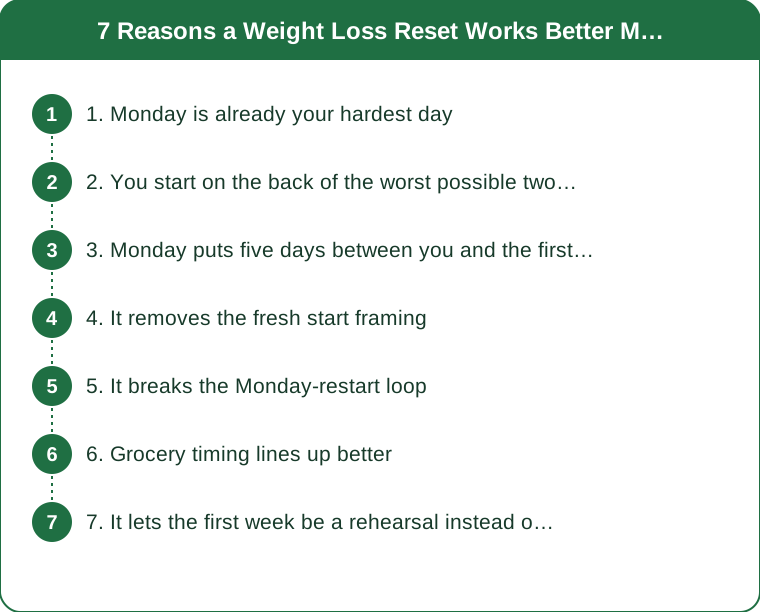
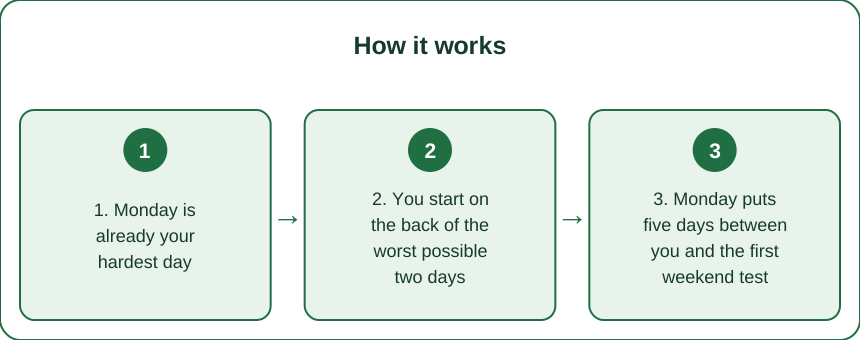
1. Monday is already your hardest day
Monday carries the highest cognitive and emotional load of the week for most people — the inbox, the meetings, the re-entry.
Adding new habits to your most demanding day is a scheduling error. Habit formation needs spare attention, and Monday has none.
Wednesday and Thursday are typically lower-stress days with more predictable schedules. Starting there means your new routines get built when you have the capacity to actually notice and repeat them.
2. You start on the back of the worst possible two days
Monday resets follow a weekend of later nights, disrupted meal timing, more alcohol, and often less movement.
You begin dehydrated, under-slept, and with a shifted appetite. The first day is therefore hardest precisely because of what preceded it, and people read that difficulty as evidence they cannot do it.
A Wednesday start follows two ordinary weekdays. You begin from a stable baseline rather than from a recovery deficit.
3. Monday puts five days between you and the first weekend test
Five days of building momentum sounds good and works badly. You arrive at Friday having spent your novelty and willpower, facing the hardest social eating of the week.
Starting Wednesday means your first weekend comes at day three or four — early enough that motivation is still high, and short enough that a partial weekend does not feel like it has erased a whole week’s work.
You also get the weekend rehearsal early, which is when you learn what your actual plan needs to handle.

4. It removes the fresh start framing
Monday carries enormous symbolic weight, and symbolism is what makes an all-or-nothing mindset possible.
When the start is symbolic, the slip becomes symbolic too. One off-plan meal on a Monday-started week feels like the week is ruined, so people write off the remaining days and wait for the next Monday.
A Wednesday has no story attached to it. That makes it much harder to treat any single meal as a verdict on the whole attempt — which is the main thing that keeps people going.
5. It breaks the Monday-restart loop
If your pattern is to restart every Monday, then Monday itself has become part of the cycle: strict early week, loose weekend, restart.
Starting midweek disrupts the loop structurally. You are no longer running the same script with the same beats, which is often what is needed after several failed attempts.
People who have restarted on many Mondays frequently find that simply changing the start day makes the attempt feel different — and that novelty is doing real work.
6. Grocery timing lines up better
Monday plans typically depend on a Sunday shop, done while tired at the end of a weekend, often without a real plan.
A midweek start lets you shop on a Tuesday evening with a specific two-day plan — a much smaller, more accurate shop that does not require predicting a whole week.
It also means your fresh produce arrives midweek rather than being five days old by Friday, which is a small thing that quietly determines whether you cook.
7. It lets the first week be a rehearsal instead of a verdict
A Wednesday start naturally gives you a short first week — three or four days. That reframes it usefully.
Treat it explicitly as a test run. The goal is not perfection; it is finding out which meals are too complicated, when you get hungry, and what the weekend needs.
Then the following Monday becomes week two of something already running rather than day one of something new. Starting midweek is how you arrive at Monday with momentum instead of expectation.
This is general information, not individual medical or nutrition advice. Speak to a healthcare professional before starting a significant dietary change, especially if you have a health condition.
TL;DR:
- Monday is your highest-stress day and habit building needs spare capacity — start when you have some.
- A Monday start follows the weekend’s worst sleep and eating, so day one is artificially hard.
- Midweek starts put your first weekend at day three or four, while motivation is still high.
- Removing the fresh-start symbolism removes the all-or-nothing framing that turns one meal into a failed week.
- It structurally breaks the strict-week, loose-weekend, restart-Monday loop.
- Shopping midweek for a two-day plan is smaller, more accurate, and more likely to result in cooking.
- A short first week is a rehearsal, so you reach Monday already running instead of starting over.
The reason your resets keep dying on Thursday may have nothing to do with your plan and everything to do with the day you keep choosing to begin. Start on a Wednesday and the first week gets to be practice.
Keep Reading
This article is for general informational and styling purposes only. Fit, sizing, and product availability may vary.