7 Reasons Your Weight Loss Reset Fails in the First Ten Days
Quick Answer: Most resets fail in the first ten days for structural reasons, not motivational ones: the change is too large to sustain, the early water-weight drop sets false expectations, hunger arrives before habits form, and the plan has no provision for a bad day. Resets that survive start smaller than feels satisfying, change one or two things at a time, and build in a written plan for the day everything goes wrong — because that day is coming.
Monday was excellent. Tuesday was excellent.
Thursday evening something happened, and by Sunday the whole thing had quietly ended.
This has a pattern, and the pattern is fixable.

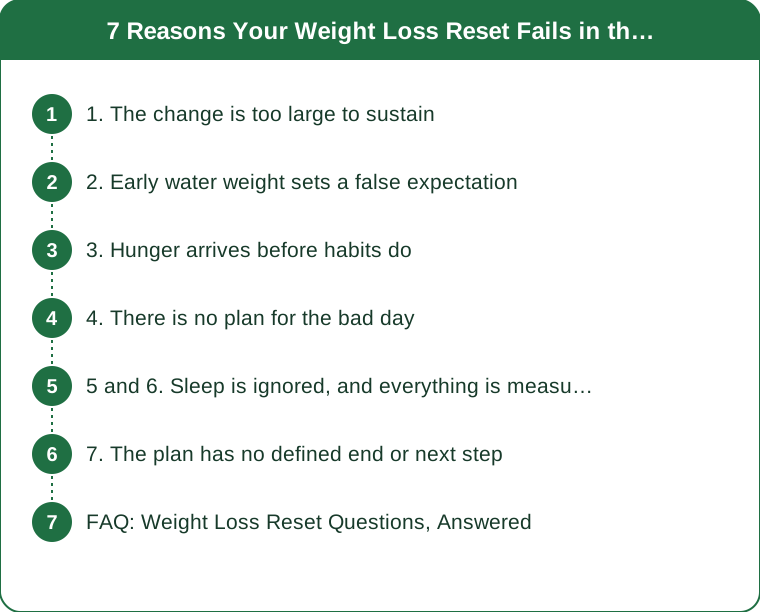
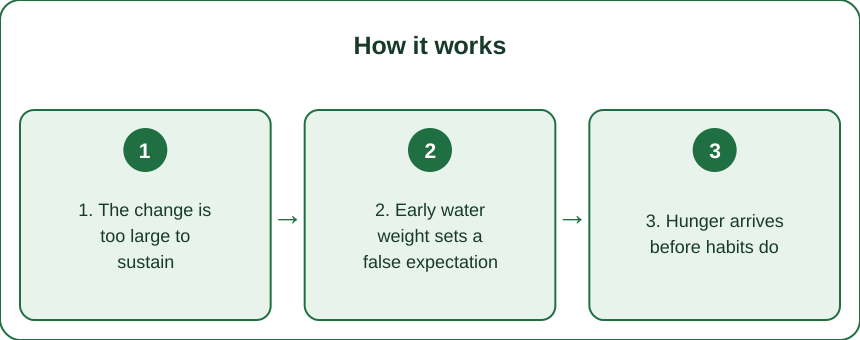
1. The change is too large to sustain
The single most common cause, and it feels like the opposite of a problem at the start.
Ambition peaks at the beginning. Motivation is highest on day one, so people design a plan that only day-one motivation can execute.
Every element has a failure rate. A plan changing six things has six chances to break, and they compound.
A 1,200-calorie target from a 2,300-calorie baseline is not sustainable. A deficit of 300 to 500 calories produces steady loss and survives contact with real life.
Start smaller than feels satisfying. If the plan feels a bit too easy on day one, it is roughly right.
2. Early water weight sets a false expectation
The first week lies, in a specific and predictable direction.
Reduced carbohydrate intake releases glycogen and its bound water. This commonly produces 1 to 3kg in the first week and it is not fat.
Week two looks like failure by comparison. Actual fat loss of 0.5 to 1kg weekly feels like a stall next to week one.
People respond by cutting harder. Which increases hunger, reduces adherence, and accelerates the collapse.
Expect it and name it in advance. Knowing week one is mostly water removes the week-two disappointment entirely.
3. Hunger arrives before habits do
The timing mismatch is the core structural problem of any reset.
Behaviour change takes weeks to become automatic, considerably longer than most estimates suggest.
Hunger arrives on day two. So the hardest period is precisely when you have the least automatic support.
Protein and fibre are the practical answer. Both increase satiety substantially — aim for protein at every meal and 25 to 30g of fibre daily.
Volume matters psychologically. Large low-calorie meals — vegetables, soups, salads — outperform small dense ones for adherence even at identical calories.

4. There is no plan for the bad day
Every reset meets one, usually within the first fortnight.
The bad day is inevitable. A late meeting, a birthday, a genuinely awful Tuesday.
Without a plan, one bad day becomes a bad week. This all-or-nothing response ends more resets than hunger does.
Write the plan in advance. A specific fallback: what you eat when the day collapses, what the minimum acceptable day looks like.
Adopt the next-meal rule. The only rule that matters is that the next meal is back on plan. Not tomorrow, not Monday — the next meal.
5 and 6. Sleep is ignored, and everything is measured by the scale
5. Sleep is ignored entirely
The variable nobody puts in the plan and everybody feels.
Short sleep raises hunger hormones and reduces satiety signalling. The effect on appetite is measurable and significant.
Tired people make worse food decisions. Self-regulation is depleted by fatigue, reliably.
Late nights add an eating opportunity. More waking hours means more food, straightforwardly.
Sleep may be the highest-return change of all. For many people, fixing sleep does more for intake than any dietary rule they could write.
6. Everything is measured by the scale
The wrong instrument, checked too often.
Daily weight fluctuates 1 to 2kg from fluid, food volume, salt and hormonal cycle. Daily readings are mostly noise.
Weekly averages are the useful measure. They smooth the noise and show the actual trend.
The scale cannot see composition change. Losing fat while gaining muscle produces a flat scale and a considerably better outcome.
Add other measures. Waist circumference, how clothes fit, energy levels, training performance. Four signals beat one.
7. The plan has no defined end or next step
Resets are treated as a sprint with no finish line.
Indefinite restriction is unsustainable by definition. Without a defined length, the plan has no completion — only eventual failure.
Set a period: 8 to 12 weeks. Long enough to matter, short enough to complete.
Plan the maintenance phase before you start. What happens after is what determines whether any of it lasts.
Deliberate maintenance periods work. Alternating a deficit phase with a maintenance phase improves both adherence and long-term outcomes.
Autumn note: September is the most common reset month after January, and it is a genuinely good time — routines are re-forming anyway. Use the structure the season provides rather than relying on willpower.
This is general information, not medical advice. Anyone with a history of disordered eating or a relevant medical condition should work with a professional.
FAQ: Weight Loss Reset Questions, Answered
How big a calorie deficit should I start with?
300 to 500 calories below maintenance. Larger deficits produce faster loss and much worse adherence.
Why did I lose 2kg in week one and nothing in week two?
Week one was largely glycogen and water. Week two is the real rate, and it looks disappointing only by comparison.
How many things should I change at once?
One or two. Sequential changes stick considerably better than simultaneous overhauls.
Should I weigh myself daily?
Only if you track the weekly average and ignore individual readings. Otherwise weekly is less stressful and just as informative.
What if I have a bad day?
The next meal is back on plan. That is the entire recovery protocol, and it works.
How long should a reset last?
8 to 12 weeks, followed by a deliberate maintenance period. Open-ended restriction has no completion point.
TL;DR:
- Resets fail from structure, not willpower: too large a change, no bad-day plan, no defined end.
- Start with a 300 to 500 calorie deficit and change one or two things, not six.
- Week one is water — expect week two to look like a stall and do not cut harder.
- Sleep may be the highest-return variable, and it is almost never in the plan.
- Measure weekly averages plus waist and clothes, and run the reset for 8 to 12 weeks with a maintenance phase planned.
Write your bad-day plan before you start. It is the one page that decides whether the other pages matter.
Keep Reading
This article is for general informational and styling purposes only. Fit, sizing, and product availability may vary.