7 Reset Mistakes That Make Week One Feel Impossible
Quick Answer: Most failed resets fail in the first seven days, and almost always for structural reasons rather than willpower ones: too many changes at once, an aggressive deficit, no plan for the specific hard moments, and metrics that guarantee early discouragement. Fix those four and week one becomes an ordinary week rather than a test of character.
You have started before. It went well for four days and fell apart on Wednesday evening. That pattern is so consistent across so many people that it is clearly not a personal failing, it is a design problem.

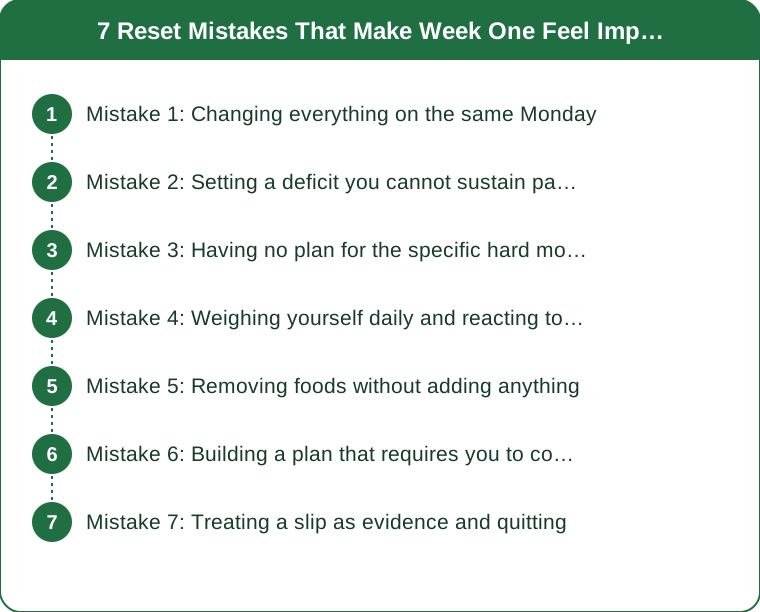
Mistake 1: Changing everything on the same Monday
The most common and the most costly.
A typical reset starts with a new eating pattern, a new training schedule, an earlier wake time, cutting alcohol, cutting caffeine, and a new sleep routine, all beginning simultaneously.
Each of those individually is a real behavior change requiring attention and effort. Stacked together they consume more self-regulation than anyone has available on an ordinary week that also contains a job, a commute, and other people.
The failure mode is predictable: one thing slips, that slip feels like proof the whole project has failed, and everything else is abandoned along with it.
The fix: pick two changes for week one. Two. Add a third in week three, once the first two require less conscious effort. This feels absurdly slow at the start and is dramatically faster in aggregate, because a sequenced plan is one you are still following in March.
If you must pick two, pick the ones with the largest effect and the lowest friction. For most people that is a protein target at each meal and a consistent bedtime, both of which improve everything else downstream without requiring much active management.
Mistake 2: Setting a deficit you cannot sustain past Thursday
The size of a calorie deficit determines both the rate of loss and the probability of quitting, and those two pull in opposite directions.
An aggressive deficit produces fast early results, which is genuinely motivating. It also produces significant hunger, low energy, poor training quality, irritability, and preoccupation with food. By day five those effects are compounding, and the evening compensation that follows is close to inevitable.
A moderate deficit produces slower results and is survivable, which means it is still running in week eight when the aggressive version stopped in week two.
The fix: aim for a rate of loss that is a modest fraction of body weight per week rather than a dramatic one, and expect the process to take longer than the internet suggests. Roughly half a percent to one percent of body weight per week is a commonly cited sustainable range, with people carrying more weight tolerating the higher end better.
The deeper issue is that a reset framed as a short sprint invites an unsustainable deficit, because it only has to last a few weeks. Framing it as the first month of a longer change removes the incentive to over-restrict.
This is general information, not medical or nutritional advice, and anyone with a history of disordered eating or a medical condition should work with a professional rather than self-prescribing a deficit.
Mistake 3: Having no plan for the specific hard moment
Everyone has one. For most people it is between 4pm and 9pm, and for many it is one particular situation.
The generic plan, eat better, does nothing at 7pm on a Wednesday when you are tired and the kitchen is right there. What works is a specific decision made in advance for a specific recurring moment.
The fix: identify your one hardest recurring moment, honestly, and design for exactly that.
If it is the drive home, the plan is a snack in the car at 4:30. If it is after the kids go to bed, the plan is a specific thing you will have and a specific place you will sit that is not the kitchen. If it is the office kitchen at 3pm, the plan is a food you actually like, brought from home, eaten at 2:45.
The pattern is the same in every case: a pre-made decision, a specific food, and a specific time, aimed at one moment. Not a rule about the whole day.
Most people who fail week one do not fail across the day. They have four good decisions and one bad one, in the same slot, every day. Solving that one slot solves the week.

Mistake 4: Weighing yourself daily and reacting to it
Body weight fluctuates by several pounds within a week for reasons that have nothing to do with fat.
Water retention from a salty meal, glycogen changes from a training session, digestive contents, cycle phase, and sleep quality all move the scale independently of the thing you are trying to change.
The result is that a person losing fat steadily will see the scale go up on multiple days in any given week. If those days are interpreted as failure, the emotional cost is high and often terminal for the project.
The fix: either weigh daily and only look at a seven-day average, or weigh once a week under identical conditions and expect noise. The daily-with-average approach is better if you can genuinely ignore the individual numbers, and worse if you cannot.
Add non-scale metrics deliberately. How clothes fit at the waist, training performance, energy at 3pm, sleep quality, and how often you think about food are all real signals and none of them fluctuate the way the scale does.
Week one is the worst possible week to judge anything by weight, because the early drop is largely glycogen and water and the subsequent plateau is normal and predictable. Knowing that in advance prevents the day-eight discouragement that ends so many attempts.
Mistake 5: Removing foods without adding anything
A reset defined entirely by subtraction leaves you eating less of what you liked and nothing in its place.
This makes every meal feel like a loss, which is exhausting, and it usually leaves the meal less satisfying in ways that produce hunger two hours later.
The fix: lead with addition. Add protein to each meal. Add a vegetable to lunch. Add a fiber source to breakfast. These crowd out other things naturally and they make the meals more satisfying rather than less.
Protein in particular does disproportionate work here. It is the most satiating macronutrient per calorie, it supports lean mass retention in a deficit, and hitting a sensible target at each meal reduces the evening hunger that drives most week-one failures.
Fiber and volume matter for the same reason. A meal with substantial vegetable volume and a protein anchor stays satisfying at a lower calorie total than the same calories in a more concentrated form.
The practical version: before removing anything from a meal, ask what should be added to it. Most of the removal takes care of itself once the meal is genuinely filling.
Mistake 6: Building a plan that requires you to cook every night
Ambitious meal plans assume a version of your week that does not exist.
By Wednesday, with a late meeting, a tired body, and nothing thawed, the plan requires more than the day has left in it. That is when the takeaway happens, and then the plan is broken and the whole thing is abandoned.
The fix: build in the low-effort options deliberately rather than treating them as failures.
Have two or three specific meals that require under ten minutes and no decisions. Frozen vegetables, pre-cooked protein, a bag of microwave rice. Know exactly what they are and keep the ingredients permanently stocked.
Have one restaurant or takeaway order you have already decided is fine. Not a compromise, a planned option. This removes the all-or-nothing dynamic that turns one convenient meal into an abandoned week.
Batch one component rather than whole meals. Cooking a large amount of one protein on Sunday is far more useful and far less tedious than assembling five identical containers, and it survives a change of plans.
The honest framing: a plan that works on your worst day is a plan. A plan that only works on your best day is a wish.
Mistake 7: Treating a slip as evidence and quitting
This is the one that converts a difficult week into a failed attempt, and it is entirely about interpretation.
A single high-calorie meal has a small effect on a weekly total. A single missed workout has a small effect on monthly training volume. Neither of these matters much in isolation.
What matters enormously is what happens next. The response of writing off the rest of the day, then the rest of the week, then the whole attempt, is what produces the actual setback, and it is a reasoning error rather than a nutritional one.
The fix: decide the rule in advance, before you need it. The next meal is the next meal. That is the whole rule.
It helps to build a slip into the plan explicitly. Assume there will be two or three off-plan meals in the first month, because there will be, and a plan that accounts for them is not derailed by them.
It also helps to notice that consistency is a percentage, not a binary. Eighty percent adherence sustained across three months beats one hundred percent adherence sustained for nine days, by an enormous margin, and it is not close.
FAQ: Reset Questions, Answered
How long before week one stops feeling hard? Usually ten to fourteen days for the food side, as hunger cues adjust and the new patterns require less active attention. Sleep and training changes often take a bit longer.
Should I start on a Monday? Start on whatever day your week is structurally easiest, which for many people is not Monday. Starting on a Thursday and getting through a weekend early builds more confidence than starting on the easiest days and hitting the hard ones tired.
What if I have failed at this many times? That is information about the design of the previous attempts, not about you. Look at where each one broke, and you will usually find the same one or two of the mistakes above every time. Fix those specifically.
TL;DR:
- Pick two changes for week one, not seven; sequence the rest over the following month
- Choose a moderate deficit you can hold past Thursday rather than a fast one you cannot
- Design for your one hardest recurring moment with a specific food at a specific time
- Judge by seven-day averages and non-scale markers, never by day-to-day weight
- Lead with addition, keep ten-minute meals stocked, and decide in advance that a slip ends at the next meal
Pick your two changes for week one right now and write them down. That single act of narrowing is the difference between this attempt and the last one.
Keep Reading
This article is for general informational and styling purposes only. Fit, sizing, and product availability may vary.