6 Reset Habits That Work Better Than Starting Over on Monday
Quick Answer: The full restart fails because it treats a bad week as evidence that the system was wrong, then replaces a system you had partial adherence to with a stricter one you’ll have less. Partial recovery — resuming one component immediately — consistently outperforms waiting for a clean slate.
You had four decent days and three bad ones, so you’re throwing out the whole plan and starting fresh on Monday with a stricter version. That sequence is the actual problem, and it repeats because it feels like taking it seriously.

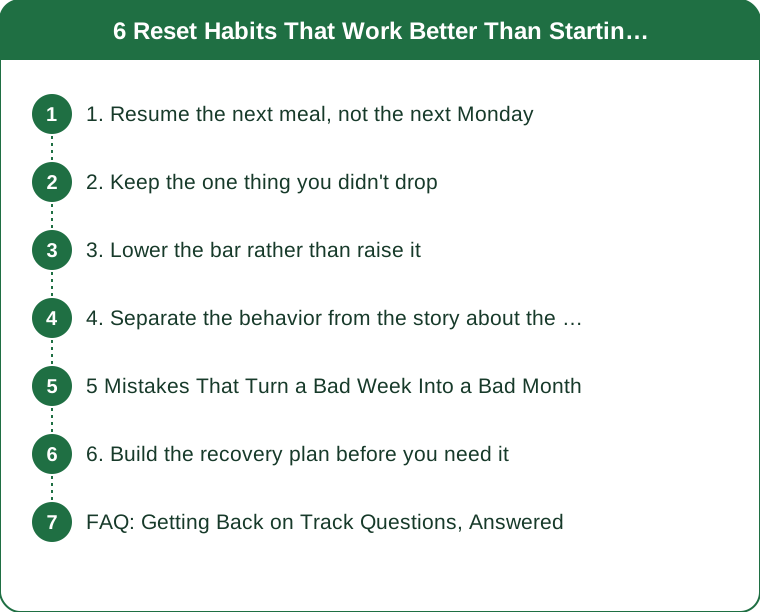
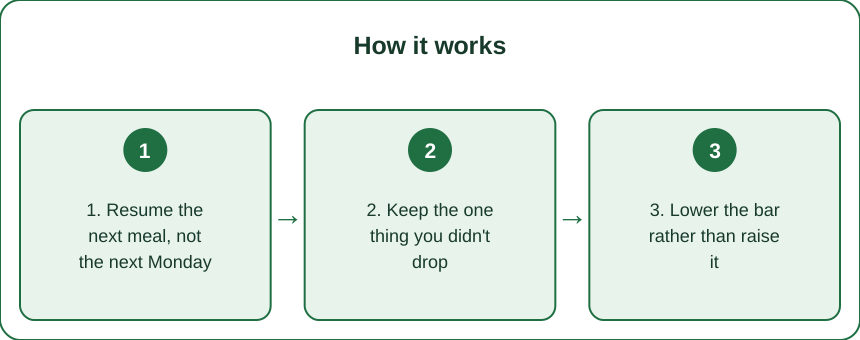
1. Resume the next meal, not the next Monday
The interval between the lapse and the resumption is where the real damage happens. Three bad days costs very little. Five days of waiting for Monday while abandoning everything costs considerably more.
Resume at the very next decision point — the next meal, the next morning, the next scheduled session. This single change removes most of the cost of a lapse, because the lapse was never the expensive part. The waiting was.
2. Keep the one thing you didn’t drop
In almost every bad week, something survived. You still walked. You still slept reasonably. You still hit protein on two days.
A full restart discards the surviving component along with everything else, because it treats the plan as a single unit. Identifying and protecting what held gives you a foundation instead of a blank page, and blank pages are much harder to build from than partial ones.
3. Lower the bar rather than raise it
The instinctive response to falling short is to make the plan stricter, on the theory that the failure was insufficient commitment. This usually shortens the next attempt.
The more effective move is the opposite. If you were aiming for four sessions a week and managed one, aim for two, not five. A plan you complete builds the identity and momentum that a plan you abandon destroys. Difficulty is not the same as effectiveness, and the two get confused constantly here.

4. Separate the behavior from the story about the behavior
A missed week is a missed week. The interpretation — I have no discipline, I always do this, I’m not the kind of person who sticks with things — is a separate thing you added, and it’s the part that causes the abandonment.
The behavioral fact is small and recoverable. The story is large and demoralizing. Getting specific about what actually happened — I skipped Tuesday because of a late meeting, and then Wednesday because I’d already skipped Tuesday — usually reveals a solvable scheduling problem rather than a character one.
5 Mistakes That Turn a Bad Week Into a Bad Month
Mistake 1: waiting for a symbolic date. Monday, the first of the month, and January are all arbitrary. The next meal is available immediately.
Mistake 2: adding a punishment. Compensating with an extra-hard session or a restrictive day frames the plan as something you can owe, which is a fast route to abandoning it.
Mistake 3: rewriting the whole plan. Redesigning is a very convincing form of procrastination. The plan was probably fine.
Mistake 4: telling nobody. A lapse held privately grows. Saying it out loud once usually cuts it back to actual size.
Mistake 5: measuring the week instead of the month. The fifth is the one that quietly does the most damage — a bad week inside a good month is normal variation, and only weekly framing makes it look like failure.
6. Build the recovery plan before you need it
The best time to decide how you’ll respond to a bad week is a week when things are going well, because in the moment you’ll be making the decision under exactly the conditions that produce all-or-nothing thinking.
Write three lines somewhere you’ll find them: what the minimum version of the plan is, which single component you protect first, and what the next decision point is. People who have this written down recover in days. People who don’t tend to recover in weeks, or start over in January.
What this looks like written out
Minimum version: two sessions, protein at breakfast. Protected component: the morning walk. Next decision point: tonight’s dinner. That’s the whole document, and it does more work than any amount of resolve summoned in the moment.
FAQ: Getting Back on Track Questions, Answered
Isn’t starting fresh sometimes genuinely useful?
A real redesign makes sense when a plan repeatedly fails for structural reasons — wrong schedule, wrong format. It rarely makes sense after a single bad week.
How long is too long to be off track?
There’s no threshold that changes the answer. The best move is the same whether it’s been three days or three months: resume the smallest version at the next decision point.
Does tracking help or make all-or-nothing thinking worse?
It depends on what you track. Tracking streaks amplifies all-or-nothing responses. Tracking totals over a month tends to reduce them.
TL;DR:
- The lapse costs little; waiting for a clean slate costs a lot
- Resume at the next decision point, not the next symbolic date
- Protect whatever survived the bad week instead of discarding everything
- Lower the bar after a lapse rather than raising it
- Write your recovery plan while things are going well, not in the moment
Nothing about a bad week requires a new plan. It requires the old plan, resumed smaller, at the next available opportunity.
Keep Reading
This article is for general informational and styling purposes only. Fit, sizing, and product availability may vary.